Field Guide · 8 min read · Hearth & Homestead Engineering Desk
The Grain Mill Test: Stone Versus Steel Burrs
Milling your own flour is the cheapest upgrade in this catalogue and the easiest one to buy wrongly. The hard part is not the mill — it is what the burrs are made of.
Milling your own flour is the cheapest upgrade in this catalogue and the easiest one to buy wrongly. The mill is not the hard part. The burr material is.
What The Burr Actually Does
A grain mill does not cut grain. It crushes it between two abrasive surfaces held at a precise gap. Everything that matters about a mill — heat, throughput, and what it can and cannot grind — comes from what those surfaces are made of.
There are two answers on the market, and they are not interchangeable.
Stone
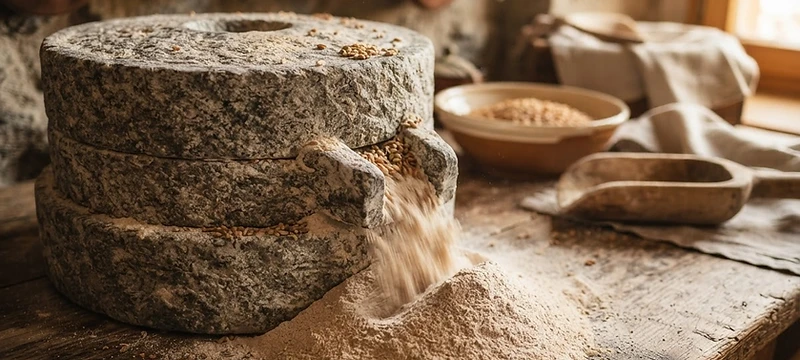
Modern stone burrs are not quarried rock. They are a composite of corundum — aluminium oxide — bound in ceramic and cast into a cone or disc. That is why a good stone mill holds its gap for years without adjustment.
Stone crushes gently and slowly. Grain passes between two abrasive faces across a large contact area, so flour comes away cooler than most steel designs manage at the same throughput. For wheat, rye, spelt and barley, stone is the better burr.
What stone cannot do:
- Oily seeds. Flax, sunflower and peanuts smear across the abrasive face and clog it.
- Very hard grains. Corn is the classic casualty. Field corn wears a stone burr noticeably faster than wheat.
- Wet or sprouted grain. Anything above roughly 15 percent moisture gums the surface.
A stone burr also cannot be sharpened. It wears in, not out, and when it finally loses its bite it is a replacement part, not a service job.
Steel
Steel burrs are cut rather than cast, and they behave differently. The teeth shear grain instead of crushing it, which runs cooler at high throughput and survives the hard grains and oily seeds that would ruin a stone.
The trade is heat. Steel can run hotter than stone at the same grind setting, and flour temperature is the variable that actually damages what you are making.
Heat Is The Real Enemy
Whole grain flour contains the germ, and the germ contains oils and enzymes. Push flour temperature past roughly 120°F and you begin degrading both. You will not notice it in a loaf that week. You will notice it in flour that has gone stale in a month instead of three.
Two habits control it, and both work on either burr type:
- Grind in two passes. Crack the grain coarse, let it cool, then take it to the final setting. The motor works less and the flour stays cooler.
- Feed it slowly. The hopper does not care about your schedule. The burrs do.
The Throughput Arithmetic
The Mockmill 100 Stone Grain Mill grinds about 100 grams a minute on a 120V/360W motor.
| Rate | Per minute | Per hour |
|---|---|---|
| 100 g/min | 3.5 oz | 13.2 lb |
A two-pound loaf needs about 1.2 lb of flour, which is under six minutes of grinding at full rate. Add a coarse pass and a re-grind and the honest figure is closer to ten minutes. The machine is not the bottleneck in a bread week.
Where the arithmetic changes is batch baking. Ten pounds of flour is roughly forty-eight minutes of continuous grinding — a long run for a 360W motor and a 2.4 lb hopper you will refill four times.
Grind little and often. Fresh flour is the entire point, and a mill that turns grain into a season of stale flour has solved the wrong problem.
Freshness, And Why It Forces Your Hand
Whole wheat flour is not shelf stable. The bran and germ carry oils that oxidise, and the flour loses its character in roughly two to three weeks at room temperature.
That leaves three options, and only one of them is good:
- Grind a month at a time and store it warm — you will be baking with flat flour by week three.
- Grind weekly, keep it in the freezer in an airtight jar, and use it cold.
- Buy commercial whole wheat flour, which has already had most of the germ removed to make it stable.
The third option is why supermarket whole wheat tastes the way it does. Milling at home is the only way to get the germ back.
Hard Wheat, Soft Wheat
Match the grain to the job and the mill behaves predictably:
| Grain | Protein | Setting | Use |
|---|---|---|---|
| Hard red spring wheat | 12 to 14% | Fine, two passes | Bread |
| Hard white wheat | 11 to 13% | Fine | Bread, lighter crumb |
| Soft white wheat | 8 to 10% | Coarse | Pastry, biscuits |
| Rye | 10 to 12% | Coarse | Sourdough, dense loaves |
| Corn, dent or flint | — | Steel burr only | Cornmeal, polenta |
Note the last row. If cornbread is part of your kitchen, that decision is already made.
Footprint And Power
The Mockmill 100 is 6 by 8 by 15 inches and draws 360W — under three amps, so it runs on any standard circuit without a second thought, and a portable station will carry it through an outage.
Hopper capacity is 2.4 lb, so plan on refilling during any long run. It sits on a counter at working height. It is not a bulk grinder and does not pretend to be.
Choosing
- Wheat, rye, spelt, barley, and you bake weekly: stone. The gentler crush and wider contact area are worth it.
- Corn, oily seeds, legumes, or one mill for everything: steel.
- Both, eventually: most serious home bakers end up here, and it is a defensible place to land.
If you are still deciding, start with wheat. It is what you will mill most, it is the easiest to source locally, and it is where the difference between fresh and bought flour shows up most obviously in the loaf.
The Mockmill 100 is the stone burr we catalogue — 100 g/min, 360W, and a footprint that fits a normal kitchen counter.
§ Referenced In This Entry
The Equipment We Used
We do not stock these systems. They are sold direct by the maker. Where our referral arrangement with a brand is approved we publish a tracked link and earn a fee; where it is still being finalised the entry stays editorial and links to our own write-up.
Harvest & Preservation
Mockmill 100 Stone Grain MillNeed someone to run the numbers?
Talk to the Engineer
Our Off-Grid Systems Engineer will size the load, the footprint and the freight access for your site.