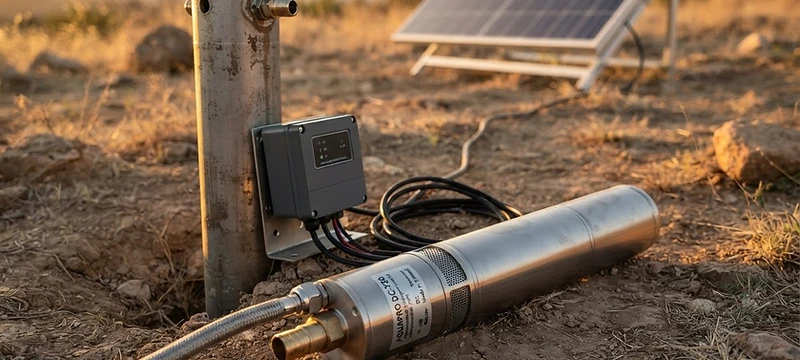
Head first, then daily volume, then array. Every published flow figure is quoted at some head, and it is meaningless without it — here is how to work out the number that actually matters.
A solar well pump is the one off-grid system where guessing is expensive, because the pump either lifts water from your depth or it does not, and no amount of additional array will fix a pump matched to the wrong head.
Sizing runs in a fixed order: head first, then daily volume, then array.
Total Dynamic Head
Head is not your well depth. It is the total vertical distance the water must be lifted, plus the losses it picks up along the way.
TDH = static water level + drawdown + rise to tank + friction loss
- Static water level — the depth to water with the pump off. Measure it. Do not assume it equals the drilled depth.
- Drawdown — how far the level falls while the pump runs. On a low-yield well this can be 20 ft or more, and it is the number people forget.
- Rise to the tank — vertical height of your storage or pressure tank above the well head.
- Friction loss — resistance through the pipe. In 1-inch poly at around 5 gallons per minute, budget 2 to 4 ft of head per 100 ft of run.
Friction is the quiet one. A 400 ft run of undersized pipe can add more head than 60 ft of real lift, which is why moving up a pipe size is often cheaper than moving up a pump.
A Worked Example
| Component | Value |
|---|---|
| Static water level | 120 ft |
| Drawdown under load | 15 ft |
| Rise to the cistern | 20 ft |
| Pipe run | 150 ft of 1-inch poly, about 4 percent loss |
TDH = 120 + 15 + 20 + 6 = 161 ft
A well that is 200 ft deep needs a pump sized for roughly 160 ft of head. That is the figure that goes to the pump curve, not the depth on the driller's report.
Daily Demand
Now size the volume, and add it up honestly — including animals and garden, because they are usually the larger half.
| Use | Calculation | Gallons per day |
|---|---|---|
| Household, 4 people | 20 gal each | 80 |
| Goats, 8 head | 2 gal each | 16 |
| Garden, peak summer | one deep watering | 30 |
| Total | 126 |
The published peak of a kit like the RPS 400 Solar Well Pump Kit is around 1,300 gallons a day, and that figure is quoted at shallow head. Head degrades flow, so at 161 ft expect a meaningful fraction of it — broadly a third to a half, in the 400 to 650 gallon range depending on the pump curve at that lift.
That is three to five times household demand, which sounds like waste. It is not, because a solar-direct pump does not run continuously. It runs while the sun is up and stops when the cistern is full. Oversizing the pump lets you fill storage faster and run it less, which is exactly what you want, because every hour the pump runs is an hour it wears.
Storage Beats Battery
The common mistake is buying batteries to make the pump run at night. You do not need the pump to run at night. You need water at night, and water is far cheaper to store than electricity.
A cistern on a hill is a battery made of gravity, and it never wears out. Elevation converts directly to pressure:
- 10 ft of rise = 4.3 psi
- 30 ft of rise = 13 psi
- 100 ft of rise = 43 psi
Thirty feet of fall gives 13 psi at the tap — enough for a shower and a hose, marginal for a pressure washer. Most installations want a small booster after the cistern for house pressure, and that booster is a much smaller load than the well pump.
The alternative architecture skips the cistern and pumps straight to a pressure tank with a controller. It is simpler to install and more expensive to run, because the pump must start every time a tap opens. On a solar-direct system that means every cloudy afternoon is a dry afternoon.
What A Battery Actually Buys You
Batteries belong on the house side, not the pump side — and the load there is smaller than people expect.
| Station | Capacity | AC output | What it will run |
|---|---|---|---|
| Jackery Explorer 300 Plus | 288Wh | 300W (600W peak) | Lights, a laptop, a fridge for a few hours |
| EcoFlow DELTA 2 | 1,024Wh | 1,800W (2,700W peak) | A half-horsepower pressure pump, a freezer, a dehydrator |
The dividing line is motor surge, not the wattage on the label. A capacitor-start motor draws three to five times its running watts for a fraction of a second at startup. A half-horsepower pressure pump runs at about 370W but needs over 1,100W to start — which is why the 300W station cannot do it and the 1,800W one can.
Buy the station for the loads you actually have, and size it on surge.
Sizing The Array
The kit's array is sized to the pump, not to your house, so do not try to tap it for anything else. A 400W PV array driving a solar-direct pump is a closed system: the controller tracks the array and throttles the motor to whatever the sun is delivering. There is no inverter in that path and nowhere to hang another load.
If you want a separate array for household power, size it independently and treat it as a different project.
| Load | Running watts | Surge | Pump circuit can carry it? |
|---|---|---|---|
| Well pump, solar-direct | — | — | Yes, it is the circuit |
| Pressure pump, 1/2 HP | ~370W | ~1,100W+ | No |
| Chest freezer | ~150W | ~600W | No |
What To Check Before You Order
- Measure static water level with the pump off, not the drilled depth.
- Measure drawdown during a sustained run, or ask the driller for the well's recovery rate.
- Add the vertical rise to wherever the water is going.
- Calculate friction from the actual pipe length and diameter.
- Add daily gallons at peak season, including livestock and irrigation.
Get those five numbers and pump selection becomes arithmetic. Skip the second one and you will buy a pump that cycles itself to death on a weak well, which is the most common failure we see in sizing requests.
The RPS 400 kit covers wells to 400 ft, which leaves real margin on a 161 ft head. Our engineer will run the numbers against your actual well and your freight access before you order.
§ Referenced In This Entry
The Equipment We Used
We do not stock these systems. They are sold direct by the maker. Where our referral arrangement with a brand is approved we publish a tracked link and earn a fee; where it is still being finalised the entry stays editorial and links to our own write-up.
Off-Grid Utilities
Jackery Explorer 300 Plus Portable Power StationOff-Grid Utilities
EcoFlow DELTA 2 Portable Power StationOff-Grid Utilities
RPS 400 Solar Well Pump KitNeed someone to run the numbers?
Talk to the Engineer
Our Off-Grid Systems Engineer will size the load, the footprint and the freight access for your site.