Field Guide · 8 min read · The Homestead Journal
The Barrier Layer: Mylar, Oxygen And The Long Store
Freeze drying and canning decide what leaves the garden. Barrier storage decides what is still edible when the season is a memory — and it comes down to one gas.
Freeze drying and canning decide what leaves the garden. Barrier storage decides what is still edible when the season is a memory. It is the least glamorous tier of the preservation stack, and it quietly holds more food than any other.
Every dry good you put by is in a race with oxygen. Air is about 21 percent oxygen by volume, and that oxygen does three things at once. It oxidises the oils in grain, flour and nuts until they turn rancid. It breaks down the vitamins that were the reason for storing the crop in the first place. And it leaves the eggs of any insect that came in from the field alive, and free to hatch.
Remove the oxygen and all three stop at once. That is the entire idea, and it is why a mylar pouch and an oxygen absorber are always discussed as a pair. One is the wall. The other is what happens behind it.
Two Jobs, Two Pieces Of Equipment
| Mylar Pouch | Oxygen Absorber | |
|---|---|---|
| What it does | Blocks oxygen from getting in | Removes the oxygen already inside |
| How it fails | Pinhole, bad seal, slow permeation | Undersized, or opened too early |
| Reusable | Yes, until punctured | No — consumed every single time |
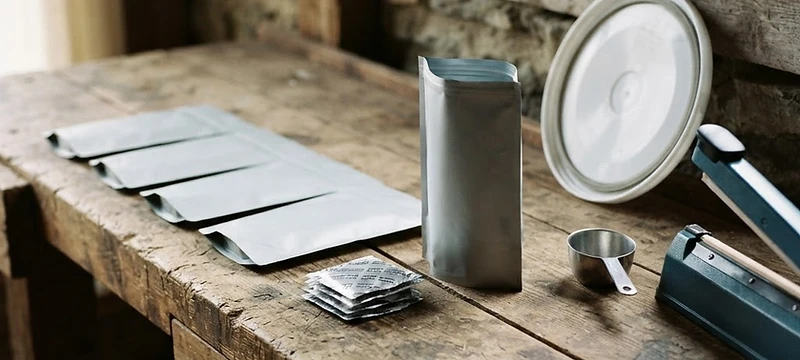
Mylar is a laminate, not a bag in the household sense: a foil layer bonded between plastic films, measured in mil. Ours are seven-mil and food grade. A freezer bag is a sieve on this timescale. A pouch is a wall.
The absorber is iron powder that rusts on purpose. Exposed to air it pulls oxygen out of the headspace and holds it as iron oxide. It does not switch off while you finish your coffee — a pack left open on the bench is a pack spent.
A pouch is only as good as its seal. An absorber is only as good as the pouch. Buy one without the other and nothing in the middle keeps.
Size The Container, Not The Weight
The most common mistake here is sizing the absorber to the pounds of food going in. The absorber is removing gas, and gas fills volume — the headspace above the grain and, just as importantly, the air held between the grains themselves.
Which is why two one-gallon pouches can want different absorbers. A gallon of wheat berries is dense and holds very little air between the kernels. A gallon of flour is mostly air by structure and takes the same absorber with margin on top. Cracked nuts hold more again.
The rule the desk works to is a single figure: 300cc to a one-gallon pouch. Start there, and size up for anything porous. If you are between sizes, take the larger one — an oversized absorber costs cents; an undersized one costs the contents.
The larger pack we size to bucket liners and dense, heavy goods is the 500cc absorber pack — check the current price on Amazon. Bucket work is a different scale of headspace, and it should be sized from the maker's own table rather than from one number.
The Twenty-Minute Window
An absorber starts working the moment its pack is cut open, and it does not wait for you to be ready. Open it, take exactly what the session needs, and get the rest back under seal.
Work in batches. Fill every pouch first, then open the absorbers once, drop them in, and seal the lot. Opening a fresh pack per pouch spends ten absorbers doing the work of four. Fill, absorb and seal inside about twenty minutes.
The Workflow
- Dry first. Moisture is not this equipment's problem, and it will not forgive you for making it one.
- Fill to the shoulder, not the brim — leave an inch or two of room for the seal and the gas.
- Lay the absorber on top of the goods, not jammed into a corner against a seam.
- Press the air out before you seal. Every litre of headspace left in is absorber capacity spent on nothing.
- Seal it. Heat-seal anything meant to keep past a year. The zip is for the pouch you open monthly.
- Label it — contents and date, written straight onto the mylar.
The Squeeze Test
A correctly packed pouch is drum-tight within a few hours. The absorber pulls the headspace down and the film draws in against the grain until the bag holds the shape of a brick.
If it is still slack the next morning, one of two things has happened: the seal has a channel in it, or the absorber never had the capacity for that volume. Open it, change the absorber, reseal, and check again. A pouch that never tightens is the only warning this system gives you — and it gives it early enough to act on.
What Belongs Behind A Barrier
| Good | Barrier store | Note |
|---|---|---|
| Wheat, rice, oats (whole) | Yes | The classic case. Dense, dry, decades of life |
| Flour, cornmeal | Yes | Holds more air than whole grain — size up |
| Beans and lentils | Yes | Slow to go rancid, quick to hatch weevils |
| Nuts and seeds | Yes | High oil. The clearest case for removing oxygen |
| Dried fruit | With care | Only genuinely dry, and test before committing a pouch |
| Sugar, salt | Unnecessary | Neither goes rancid. A bucket and a lid will do |
| Anything still damp | No | See below, twice |
What An Absorber Is Not
An oxygen absorber is not a drying agent. It removes oxygen. It does nothing whatever about water.
Put anything in that is not properly dry and the barrier does the opposite of what you wanted: it holds the moisture in, in the dark, and you grow mould in a pouch that would have been better off as a paper sack. Drying is the dehydrator's job and the freeze dryer's job. Oxygen is this one's. Do not ask one machine to do the other's work.
Where It Sits In The Stack
Four routes, four jobs, and knowing which does which is most of the discipline:
- Dehydrator — water-heavy crops, at the cheapest cost per pound.
- Freeze dryer — meals, meat, dairy, anything you want to rehydrate as a recognisable dish.
- Canner — acid and heat, in jars, on the shelf you actually cook from.
- Barrier storage — dry goods at scale, for years, in the least space.
The first three decide how much of a season you keep. The fourth decides how long you keep it — and it is the cheapest tier to enter, because the pouch is bought once and used again.
The Consumable
Everything else in this guide is equipment you buy once. The absorber is not. It is spent every time a pouch is filled, which makes it the one line in the barrier kit that behaves like a pantry staple rather than a tool — and the one thing worth keeping a spare hundred-pack of in the cupboard.
The 300cc pack is the one we size to a one-gallon pouch. The 300cc absorber pack — check the current price on Amazon — comes a hundred to the pack, and the seven-mil one-gallon pouches it goes into are sold by the maker there in packs of fifty, with absorbers bundled in.
The Arithmetic
Forty pounds of wheat is ten one-gallon pouches, ten absorbers, and an afternoon. Set against buying that same forty pounds back at retail across the next ten years, the arithmetic is not close.
The pouches last until punctured. The absorbers are the only part of the equation that expires — which makes them the only part that has to be bought twice.
A jar keeps the pantry tidy. A barrier keeps it for a decade. The difference between the two is a single gas, and a small pack of iron that wants it more than the flour does.
§ Referenced In This Entry
The Equipment We Used
We do not stock these systems. They are sold direct by the maker. Where our referral arrangement with a brand is approved we publish a tracked link and earn a fee; where it is still being finalised the entry stays editorial and links to our own write-up.
Preservation & Storage
1-Gallon Mylar Food Storage BagsPreservation & Storage
300cc Oxygen AbsorbersPreservation & Storage
500cc Oxygen AbsorbersNeed someone to run the numbers?
Talk to the Engineer
Our Off-Grid Systems Engineer will size the load, the footprint and the freight access for your site.