Case Study · 8 min read · Hearth & Homestead Engineering Desk
What A Freeze Dryer Batch Actually Costs You
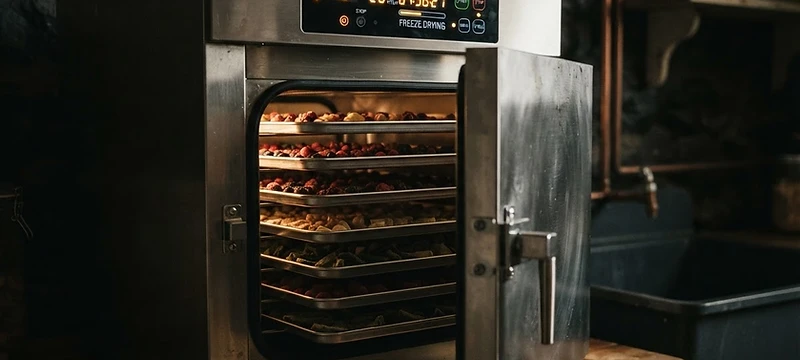
A five-tray machine turns 10 to 15 lb of fresh food into two to three pounds of shelf-stable food over a day and a half. Here is what that batch costs to run, and when the machine actually pays for itself.
The number on the brochure is 10 to 15 lb. That is fresh weight going in, and it is the one figure that does not decide whether the machine is worth owning.
Almost all of that weight is water, and freeze drying removes nearly all of it.
The Batch Number That Matters
A freeze dryer works by sublimation: the food is frozen solid, then chamber pressure is dropped until the ice turns straight to vapour without passing through a liquid phase. What leaves is water. What stays is everything else.
Most produce is 80 to 90 percent water. Take the middle of the advertised range — 12 lb of fresh food at 85 percent moisture — and you are left with roughly 1.8 lb of finished product. Run the same arithmetic across the range:
| Fresh load | Moisture | Finished yield |
|---|---|---|
| 10 lb | 85% | ~1.5 lb |
| 12 lb | 85% | ~1.8 lb |
| 15 lb | 80% | ~3.0 lb |
| 15 lb | 90% (berries, tomatoes) | ~1.5 lb |
So the honest headline for a five-tray unit is two to three pounds of finished food per cycle. And a cycle is not an afternoon: high-moisture foods commonly run 24 to 40 hours.
What A Cycle Actually Draws
The Medium Home Pro wants a dedicated 120V/15A circuit. Fifteen amps at 120 volts is an 1,800W ceiling for that breaker, and the 80 percent continuous-load rule puts practical continuous draw around 1,440W.
The machine does not sit at that ceiling. The vacuum pump pulls hard at the start, then the heater cycles against shelf temperature, so average draw over a full cycle lands well below peak. A realistic band for a medium unit on a thirty-hour cycle is 20 to 30 kWh.
At the US average residential rate of roughly $0.16/kWh:
- 24-hour cycle, about 21 kWh: roughly $3.40
- 40-hour cycle, about 30 kWh: roughly $4.80
Call it four dollars of electricity per batch, plus whatever you loaded into it.
Cost Per Finished Pound
Dividing energy cost by finished yield is where the picture sharpens.
| Finished yield | Energy cost | Energy per finished lb |
|---|---|---|
| 1.5 lb | $4.00 | $2.67 |
| 2.0 lb | $4.00 | $2.00 |
| 3.0 lb | $4.00 | $1.33 |
That looks excellent until you amortise the machine. At $2,995, spread across 500 batches — roughly twelve years at one batch a week — the hardware adds about $6.00 to every batch, or $2.00 to $4.00 per finished pound.
All in, before counting your own labour or the cost of the food, you are producing freeze-dried food at roughly $3.30 to $6.70 per finished pound.
For context, freeze-dried fruit retails at $8 to $15 per pound. The machine does beat retail — but by less than the marketing implies, and only if you keep it loaded.
The freeze dryer is not a cost-saving device at household volumes. It is a supply-control device. It turns a glut you cannot eat into a pantry you can rely on.
Where It Genuinely Beats Canning
Cost per pound is the wrong lens for some jobs.
Canning is cheap and it works, but it works by heat, and heat changes food. Tomatoes go soft, peppers lose their snap, berries become sauce. A pressure canner also holds a hard limit: low-acid vegetables and any meat must be pressure canned, not water bathed, and that is a 60 to 90 minute process per load with contents held at 240F.
Freeze drying keeps structure. A freeze-dried strawberry rehydrates into something recognisably a strawberry. A freeze-dried stew rehydrates into stew. Finished meals are the case where nothing else competes, because you can process a complete dish and reconstitute it with hot water on a trail or in an outage.
If your goal is a year of tomatoes, can them. If your goal is a shelf that survives a grid failure with food you actually want to eat, freeze dry it.
The Trays Are The Real Constraint
Five trays is 10 to 15 lb, and that ceiling is about surface area rather than volume. Loading density is the variable you control:
- even layers, no thicker than about an inch
- no overlap, or the centre of a pile stays wet while the edges turn to dust
- pre-freeze the trays if the unit has no built-in freeze step
Overloading is the most common cause of a cycle that runs fifty hours and still comes out with soft centres. Underloading costs you a cycle. No trick beats a thin, even layer.
Sizing The Circuit And The Floor
Two site requirements catch people out.
A dedicated 15A circuit means dedicated — nothing else on that breaker. Do not share it with a chest freezer. Two compressor starts on one 15A circuit will trip it, and you will lose a thirty-hour cycle at hour twenty-six.
Footprint is 25 by 30 inches standing 65 inches tall, before allowing for door swing and the space behind for the pump and drain. Give it a level, hard floor in a garage or utility room, not a kitchen corner.
Freight And Lead Time
The Medium Home Pro ships heavy LTL freight, typically in one to two weeks, palletised on a semi. That is not a parcel drop. The carrier needs a road a 53-foot trailer can take, and someone has to get it off the tail of the truck — a liftgate, a pallet jack on hard standing, or two people and a great deal of patience.
Freight access is worth confirming before you order rather than on the morning of delivery. The Harvest Right Medium Home Pro is catalogued in the Systems desk, and our engineer will check the approach to your specific site first.
What To Protect In An Outage
If preservation has to survive a grid failure, the freeze dryer is not the appliance to protect. Twenty-one to thirty kWh per cycle is far beyond any portable station — a 1,024Wh EcoFlow DELTA 2 holds about a twenty-fifth of one cycle.
Protect the small loads instead. A dehydrator draws 440W and a grinder draws around 1,100W, and both are things a portable station genuinely keeps running through an outage. Those are the appliances where battery capacity buys real resilience.
The Payback, Stated Plainly
Run 40 batches a year at two pounds finished each and you produce 80 lb of finished food annually. Against retail freeze-dried fruit at $10 per pound, that is about $800 of avoided spending, less roughly $160 of electricity — about $640 a year.
Against a $2,995 machine, that is a little over four and a half years to break even, with forty afternoons of cycle management along the way.
That is not a bad deal. It is a different deal than the brochure implies.
Before You Commit
Four questions decide it:
- Do you produce more than 100 lb a year of surplus you cannot eat fresh or can? If not, the machine sits idle and the arithmetic collapses.
- Can you give it a dedicated 15A circuit and a level floor with room for the door swing?
- Can a semi reach your door, or can you meet it somewhere a semi can reach?
- Will you run it weekly, or will it become a $2,995 shelf?
A yes to all four makes it a sound purchase. A no to the first one makes it a poor one, however good the yield numbers look.
§ Referenced In This Entry
The Equipment We Used
We do not stock these systems. They are sold direct by the maker. Where our referral arrangement with a brand is approved we publish a tracked link and earn a fee; where it is still being finalised the entry stays editorial and links to our own write-up.
Harvest & Preservation
Harvest Right Medium Home Pro Freeze DryerOff-Grid Utilities
EcoFlow DELTA 2 Portable Power StationNeed someone to run the numbers?
Talk to the Engineer
Our Off-Grid Systems Engineer will size the load, the footprint and the freight access for your site.